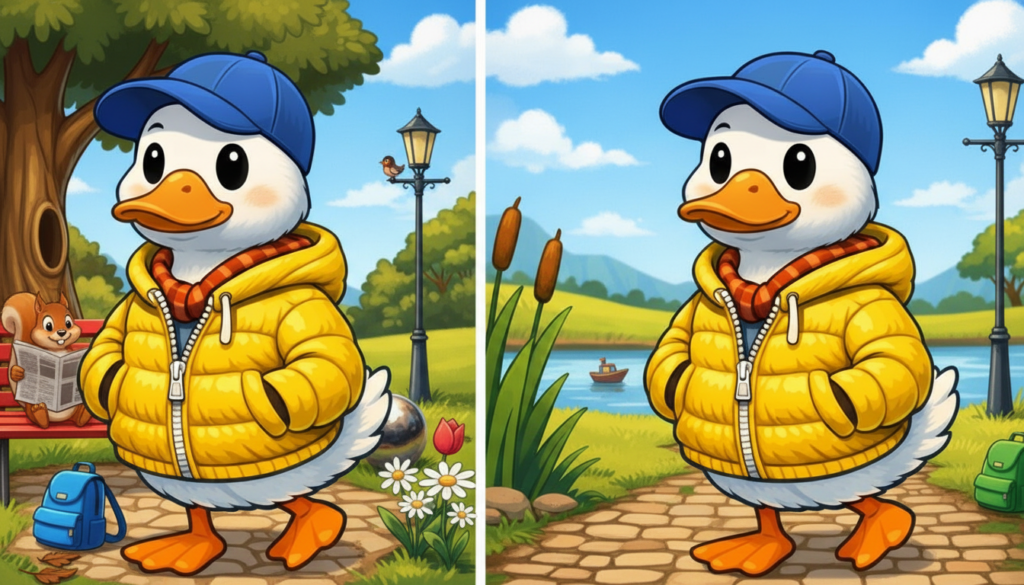
Today is going to be a lot of fun if you like optical illusions and brain teasers. We made an exciting Spot the Difference puzzle that will put your ability to notice things and your ability to think quickly to the test. This fun picture puzzle shows a cute duck wearing sunglasses and a cool jacket walking by a calm pond. But there is a catch: two almost identical images have three small differences that are hard to see. Can you find them in only eight seconds? Only those with the best eyesight will get there on time!
Visual Challenge for 8 Seconds
Why Spot-the-Difference Games Get Your Attention Right Away
For decades, Spot the Difference puzzles have been a fun way to pass the time. They are simple to understand, very interesting, and surprisingly good at improving thinking skills. These puzzles help improve your ability to see and think quickly by making you pay close attention to small details. Even though they look easy at first, the challenge gets harder when differences are cleverly hidden, which makes the brain work harder.
If you do these 8 things every morning, you’re quietly hurting your happiness.
If you do these eight things every morning, you might be hurting your happiness without even knowing it.
The fact that these puzzles are so easy to get to is what makes them so appealing. Kids can have fun with them as a game, and adults can use them as a quick and fun way to work out their brains. Spot the Difference challenges also help you remember things better, stay focused, and pay more attention to details. That’s why puzzle and brain game fans still love them.
The Duck Puzzle That Tests Your Sharpness in 8 Seconds
The puzzle for today has two pictures of a cute yellow duck wearing a jacket and sunglasses. The duck walks next to a pond in a peaceful area outside. When you first look at the pictures, they look the same, but they are not.
In just 8 seconds, you need to find three things that are different. This may seem easy, but time goes by quickly, so you need to pay close attention to all the changes before the timer goes off. You need to look closely at both pictures because the differences aren’t easy to see.
How to Scan Images Smartly Without Missing Any Details
Here are some good ways to improve your observation skills and do better on spot-the-difference puzzles:

- Begin with a quick overview: Take a quick look at both pictures to get a sense of the overall layout. This first scan helps your brain remember the most important parts before you look at the smaller ones.
- Focus on Each Part: After the quick scan, look at each part of the picture one at a time, like the duck’s jacket, the pond area, or things nearby. These focused areas usually hide small changes.
- Changes in colour, size, or shape are often small. Keep an eye out for these changes. Look closely at things that look the same in both pictures, because even small differences can help you find the difference.
- Use Balance and Symmetry: Puzzle makers often put differences in places that are balanced or mirrored. It can be easier to spot differences if you compare one side to the other.
- Set a short time limit for your training, like 7 seconds, and try to find the differences as quickly as you can. Practicing on a regular basis with a timer makes it easier for you to notice small details when you’re under pressure.
Showing the Three Secret Changes in the Jacketed Duck
Now let’s take a closer look at the three differences that aren’t obvious in the picture. Here’s a clear and detailed list of what you should be looking for if you’re ready to find them:
- The Rock That Disappears Close to the Grass
The first difference is in the bottom part of the picture, close to the grassy area. The left picture shows a small rock next to the grass, but the right picture shows that rock is completely gone. It’s easy to miss this change because it fits in with the background so well. To see this small difference, look closely at the area around the duck’s feet. - The Drawstring on the Hoodie Is Gone
The duck’s hoodie is where the second difference is. The drawstring hanging from the neckline of the hoodie is easy to see in the left picture. But the drawstring is not there at all in the second picture. It’s hard to see this small detail because the hoodies in both pictures look almost the same. To see this change, pay close attention to the neckline area. - The Frog That Is Not by the Pond
The third and last difference is close to the pond. A small frog is sitting by the water’s edge in the left picture. This is a small but noticeable detail. The frog is gone in the picture on the right. If you’re not paying close attention, you might miss this difference, but the fact that the frog is not there is a big clue. You can find this last change by carefully looking around the pond area.
How visual puzzles quietly improve your ability to observe
Spot the Difference puzzles are more than just fun. In fact, they help your brain work better. You learn to notice small things that you might not normally see in everyday life when you look for tiny differences between two pictures. Being able to notice small changes is useful in many situations. These puzzles also help you focus better. The more you practise finding differences, the better you get at paying attention. This better focus can help you do better at work or when you’re studying.
Your brain gets better at processing what you see when you play these games a lot. You also improve your short-term memory because you have to remember details from one picture while comparing them to another. This skill of being able to quickly analyse and remember information is useful all day long.
How to Get Better at Spot-the-Difference Challenges Faster
These helpful tips will help you get better at Spot the Difference puzzles and find changes faster:
- Practice Often: Regular practice helps your brain and eyes learn to see even the tiniest differences. You will get faster and better at solving puzzles the more you do them.
- Train with a Timer: Use a timer during practice to do the 8-second challenge again. Pushing yourself against the clock makes you faster while keeping your focus and accuracy.
- Pay Attention to the Little Things: A lot of differences are hidden in small details. Take a close look at patterns, textures, outlines, and small things that are easy to miss at first.