
You’ll like this one if you like optical puzzles. Both entertaining and beneficial to your brain are Spot the Difference challenges. These puzzles require concentration and keen observational abilities. A joyful boy skis down a snowy mountain in today’s entertaining challenge. In just nine seconds, you must identify three minor variations between two nearly identical pictures of this winter scene.
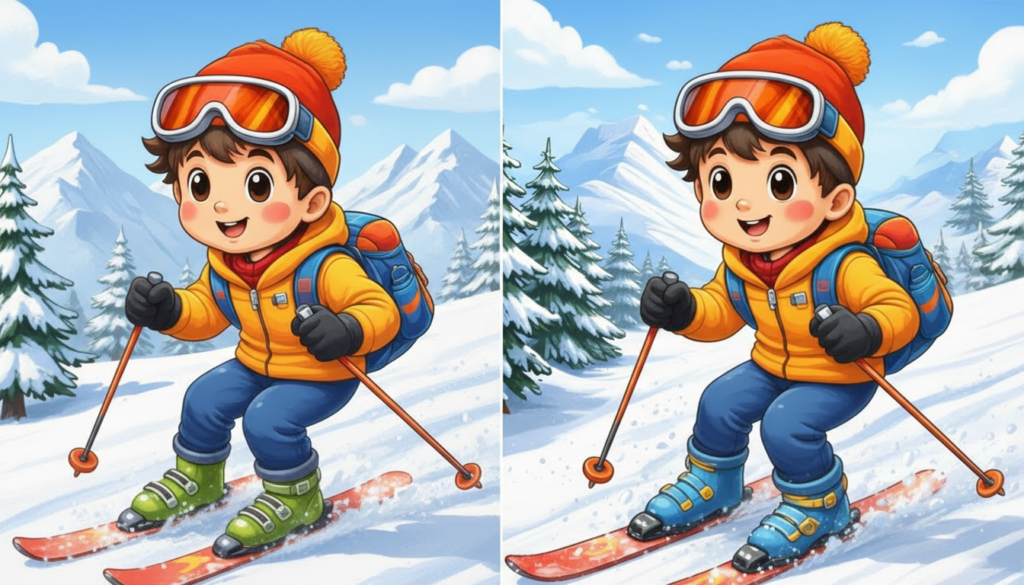
The 9th Visual Challenge
With a bright sun, snow-covered slopes, and a skier joyfully sliding down the mountain, the two pictures might initially seem to be identical. But if you examine them more closely, you’ll see that they differ in a few minor but significant ways. Before the timer goes off, can you locate them all? See how fast you can identify the changes as we dive into this entertaining brainteaser.
Why “Spot the Difference” Puzzles Are Immediately Compulsive
Spot the Difference Puzzles: An Easy Brain Exercise Due to their genuine advantages, spot the difference puzzles have been a favourite for many years. These visual games are a great way to sharpen your cognitive abilities. They are enjoyed by people as a form of amusement and as a way to maintain mental acuity.

These puzzles are still very popular for the following main reasons:
- Improved Focus and Attention: By forcing you to closely consider minute details, Spot the Difference puzzles progressively improve your focus. You can focus for longer periods of time on everyday tasks thanks to this enhanced attention.
- Improved Memory Skills: Solving these puzzles tests your ability to recall patterns, small variations between images, and visual elements. Your brain becomes more adept at remembering and storing visual information with consistent practice.
- Improved Visual Awareness: Accurate and fast visual cue interpretation is necessary to identify differences. As time goes on, this helps you become more perceptive in daily situations by honing your ability to spot patterns and details.
- Reduction of Stress and Relaxation: Solving puzzles provides a peaceful mental diversion. You feel mentally rejuvenated and at ease after completing the fun challenge, which helps divert your attention from everyday stressors.
Inside the 9-Second Test: An Explanation of the Boy Skiing Visual Challenge
Let’s move on to the exciting part: solving the puzzle! A joyful boy skiing down a mountain in a winter wonderland is the subject of today’s challenge. He stands out against the snowy slopes and clear blue sky thanks to his colourful ski attire, bright orange helmet, and ski goggles.
The sun is shining brightly in the sky above snow-covered trees in the background. Although the two images appear to be identical at first glance, closer inspection reveals three minor variations. You have less than nine seconds to identify these differences. Does that sound easy? Let’s see how you do!

Clever Scanning Methods to Quickly Solve Difference Puzzles
Here are some useful pointers to help you improve your spot-the-difference puzzle solving abilities before diving into the solution:
- Quickly Scan Both Images: To grasp the general layout, start with a brief synopsis of both images. Your brain is better prepared to detect minute changes as a result.
- Verify Symmetry: Disparities are frequently positioned in balanced or mirrored ways. Changes can be seen more quickly when comparing top to bottom or left to right.
- Pay Attention to Tiny Elements: Many differences are incredibly small, like minute changes in an object’s shape, missing lines, or modified details. The secret is to pay close attention.
- Use a Timer Challenge: Giving yourself a short amount of time, such as the 9-second challenge, increases pressure and teaches your brain to process visual information more quickly.
Practice Often: Solving these puzzles on a regular basis improves visual memory and attention to detail, which over time makes it simpler to identify differences.
The Three Hidden Shifts in the Skiing Boy Image Are Uncovered
It’s time to reveal the three hidden distinctions between the pictures. Here’s a detailed explanation of what to look for:
- The Sunray That Was Missing: The sun is where the first difference can be seen. The sun can be seen in the left image with several rays radiating outward. However, one of those rays is absent in the image on the right. It’s a subtle change, but it’s easier to identify the missing ray once you focus on the sun’s edges.
- The Scarf of the Skier: The skier’s scarf is where the second difference can be found. The scarf appears longer and floats more freely in the wind in the left image. The scarf is notably shorter and has a slightly different shape in the right image. A close examination of the scarf is necessary because this change can be difficult to notice at first glance.
- The Ski Pole Trick: The skier’s ski pole is the last distinction. A tiny detail is missing from the ski pole’s tip in the left image. That detail is easily seen in the image on the right. Even though it’s a small change, this significant difference can be seen by looking at the pole’s end.
Develop Your Eyes: Easy Techniques to Improve Visual Detection
Even if you were able to identify every difference in today’s puzzle, you will still be able to improve your skills for more difficult ones if you keep practicing. Here are some easy strategies to get better at Spot the Difference games:
- Try Different Difficulty Puzzles: As your abilities advance, take on increasingly difficult puzzles. Tougher images enhance overall observation skills and train your eyes to detect finer details.
- Divide the Image into Smaller Parts: When a puzzle seems too big to handle, divide it up into smaller parts. Slowly scan toward the center after checking the edges and corners. This approach facilitates identifying differences.
- Practice Often: Just like with any other skill, consistent practice yields significant results. Your speed and accuracy will increase if you take the time to work on these puzzles frequently.
Some differences are purposefully subtle, so exercise patience and maintain your composure. Take your time, enjoy the challenge, and don’t rush the process. It will get much easier to identify differences with time and practice.
